Will provided training increase the possibility of leadership role promotion?

Image reference: Garcia, W. (2019) Is Promotional Products a successful strategy to promote your business?. Available at: https://www.firstelse.com/is-promotional-products-a-successful-strategy-to-promote-your-business/ (Accessed: 14/03/2020).
Read time: 3 mins

When researching into leadership training, many articles and studies show that training to become a leader might not be as effective as we think. 

Article written by Aaron Levy states that leadership training is provided to employees of the company to ease the operation delivery within the organisation

It is explained that the problem with teaching a person to be a leader is that they might remember the concept thought but not how to implement the idea into reality. 

A research by Harvard Business Review shows that $356 billion have been invested globally in 2015 alone, in training employees to become leaders. The article shows that the companies investing are not getting a good return – people go back to their old ways. 

In addition, some articles and studies show that if there is not leadership training there will be a shortage of leaders. Employees need to be developed in the organisation to increase their loyalty.

 Training can increase the loyalty of the employees however, if it is not affective organization can be left with leadership gaps that result in decreased productivity. This can additionally lead to potential loss of profit. 

An organisation that provides leadership training for employees, called Dale Carnegie explain that the training that they do, can help in many areas in an organisation. 

For example, the they state that the training will increase the commitment and loyalty of the employees. Improve communication and collaboration; create a culture that retains talent and achieve organisational goals and objectives.

If a trainee does master and practice the skills mentioned, the training might increase the possibility a position of higher authority in an organisation. 

Overall, training is needed for people to develop their skills. However, the skills learned need to be practiced regularly to increase the chances of successfully leading a team. 

Are you a manager or a leader?

Image Reference: Duggal, N. (2020) What’s the difference between leadership and management?. Available at: https://www.simplilearn.com/leadership-vs-management-difference-article (Accessed: 14/03).
Read time: 3 mins

Many people can state that there is a difference between a manager and a leader. However, when asked to state the difference they do not have a certain answer. 

A study by Wayne Turk on Manager or Leader, explains that leadership and management I surly not the same however, “they can and should be combined”.

He explains that the distinction between the two is the reason that the leaders are followed by choice compared to managers; they have to be obeyed. This is due to the fact that managers are in a position of authority.

Leaders will need to be able to, set the pace, provide vision, inspire others, and more. Their skills need to go beyond to make people “believe the impossible” as mentioned by Jim Clemmons in Wayne Turk’s study.

While researching more about managers, Kotterman James’s study on Leadership Versus Management also states that leadership and management are very similar however, they are two different things. 

He explains that “mangers will need to plan and budget for projects while leaders establish direction”. He also adds that they control and resolve problems. He ends his research by stating that “managers produce standards, consistency, predictability, and order”.

In conclusion, an organisation to be successful it needs both a good leader and a competent manager. In Kotterman James’s study, he concludes by saying “It is unusual for one person to have the skills to serve as both an inspiring leader and a professional manager”.

This doesn’t mean that a manager cannot be a great leader, they need to have leadership skills to manage a project or a task however, both have their differences. 

An interesting quiz that shows if you are a leader or a follower can be found bellow:

https://www.buzzfeed.com/natalyalobanova/are-you-a-leader-or-a-follower

Guidelines to become a great leader.

Image reference:Evalart. (2019) Leadership tests in recruiting. Available at: https://evalart.com/en/blog/pruebas-de-liderazgo-en-seleccion-de-personal/ (Accessed: 14/03/2020).
Read time: 3 mins

After researching about what people consider to be the right set of skills for a leader, a realisation hit that many people might confuse a leader with a manager. 

To be an adequate leader, you need to be more supportive, encouraging and be able to motivate a workforce to strive for higher results.

On the other hand, managers need to be able to set goal, rules and direct the team while executing a mission

Small difference can have a greater meaning the business world, this is why a list will be included below to show the most popular skills that are needed for a strong leader. 

The first skills will be trust. This is not particularly a skill however, as a leader you will need to know how to make your followers trust you. This can be created by taking responsibilities, guide and support the work force.

Communication is significantly important for a leader as you will need to connect with people on an emotional level. The words that leader use need to be able to inspire and encourage others. In addition to this skill, listening is part of it because miscommunications need to be eliminated.

The leader as a person will need to be a role model for the team and has to always do what is right. With this point the team will have respect towards the team and will stay loyal and perform better to show higher results. 

Finally, leaders need to have a tactical and technical proficiencies, so they are able to control and set the team’s engagement to the task. 

Overall, leaders and managers may seem similar however, both have different set of skills and abilities to demonstrate in a team and lead to great results. 

Are women leaders?

Two years ago, we marked a century of women gaining various rights. These include voting, equal pay, applying for credit cards and loans, working in legal professions and many more. 

The movement created years ago changed the view of women in a positive light and gave hope to young women that everything is possible to become. 

However, even today women make a small percentage of senior teams and CEOs for businesses which has to be changed. Women need to be encouraged and promoted to unleash their full potential in leadership roles. 

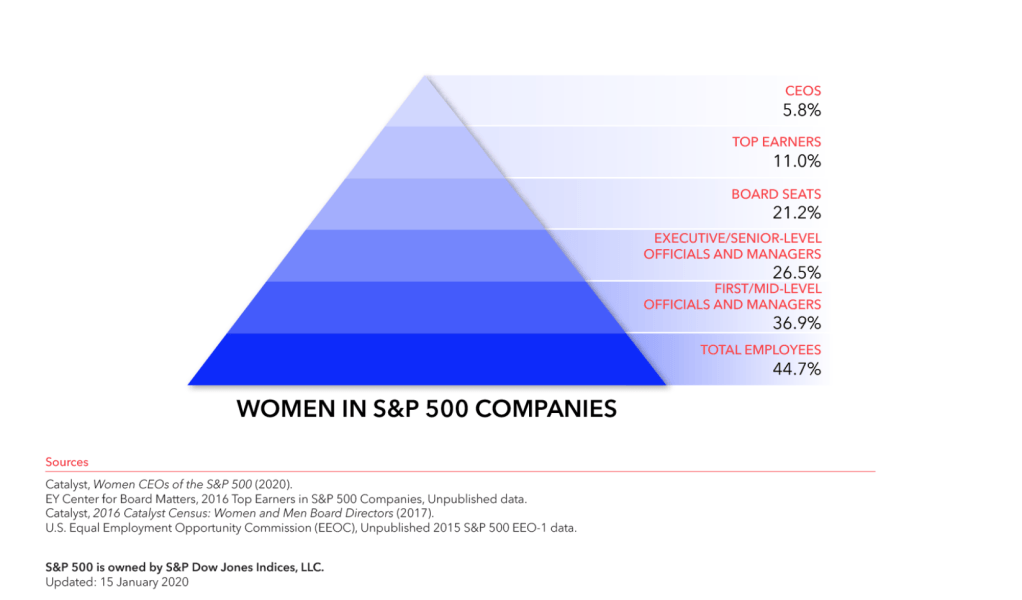
The graph below shows the percentages of women in different roles in the top 500 companies. 

As shown above, nearly 6% of 500 businesses have women CEOs and their senior management teams include only 26.5% women. 

The numbers of women leading businesses have significantly increased compared to the past however, the numbers are still low. Research done by DDI global leadership forecast, show that the 500 businesses that are ran by women “had a 20% higher stock price on average”.

In addition, the research shows that “organizations that have at least 30% women in leadership roles are twelve times more likely to excel financially”. Companies with higher gender diversity are 1.4 times more likely to have sustained, profitable growth which shows that women are needed in leadership positions. 

To support the point above, research done by Harvard business review, shows that “women are rate better than men on key leadership capabilities”. They explain that from all 19 capabilities included in the study, women outscore men with 17.

For example, practicing self-development (capability), women score 54.8% while men score 49.6%

Overall, women need to spend more time innovating and leading instead of just serving. As shown, women can increase the profitability of a business due to their leadership skills. Due to this fact more gender diversity needs to be included in higher authority positions.  

Can innovation be enhanced by diversity?

Image reference:
Lemmon, T. (2019) Lack of diversity and social mobility puts young talent off jobs. Available at: https://builtin.com/diversity-inclusion (Accessed: 08/03/2020).

Read time: 2 min

Diversity and innovation have been two big topics of discussion in recent times. As people can now move freely around the world, it is much easier for a country or a city to become multicultural. This leads to a significantly larger and diverse working hand. 

As many other megapolises, London for example, is one of the most ethnically diverse cities in the world. As it has been proven that diversity can be a strong business strategy, employers are creating more diverse workforces, which have proven to be a fantastic source for innovation.

Companies with policies that encourage multicultural workforces have been observed to produce more innovative products for a set period of time. 

NC States Pool Collage of Management Gender have constructed a study, providing information for the largest 3000 public companies, based in the United States, that have shown significant increase in innovation due to workforces being multi-ethnical. 

In addition, the study suggests that there are great advantages for companies to employ candidates from different backgrounds. ‘Greater grow options, higher cash flow, stronger governance and increase firm value’ are some that they explain. 

Image reference:
Theheartofthecity. (2019) What works in tackling gender inequality in the workplace. Available at: https://theheartofthecity.com/what-works-in-tackling-gender-inequality-in-the-workplace/ (Accessed: 08/03/2020).

Companies are facing large scales of criticism as social media platforms encourage more businesses to start offering higher job position opportunities to more multicultural individuals. ‘Especially women and minorities’ which is proven to enhance future innovation efficiently. 

Overall, diversity can be used as a business strategy to unleash the organisation’s full potential. Ensuring to eliminate blind spots and be rarely biased, will ensure that customers come back and generate more profit. In addition, this can result in attracting more stake and shareholders which will grow the business even more. 

When will we be jobless?

Image: Nayyar Gaura, (2017) 
Reading time: 5 minutes

Have you ever walked in Tesco or Sainsbury, got your favourite snack and thought ‘I will just go to the self-checkout machine, its faster’? 

This is just one example of the technologies that have been invented to replace the working hand and give a ‘faster’ experience to the customers. 

According to Smartercx “the self-checkout system market is expected to reach $4 billion by 2024

Many people may disagree with the statement above, as they might enjoy the face-to-face contact with the worker. This may give them a better customer experience which will benefit the company as well. 

While the self-checkout system market increases, more people will be losing their jobs to be replaced by a machine. A report by McKinsey estimates that by 2030, 3 to 14 percent of the global workforce will be replaced by robots. 

As technology changes our lives changes with them. Mobile phones have become meaningful assets in people’s lives (mine certainly is). It has been estimated that ‘by 2020, 50 billion smart devices’ will be operating. Just 15 years ago you had to click many times on a button to select the right letter; now we touch the letter and it appears. 

If the predictions are proven to be correct, employees would have to adapt to new skills which would be desired by employers. An article written by Alex Grey, compares the different skills demanded in 2015 and 2020. It shows that creativity is placed on third place in today’s demand. However, in 2015 the demand for creativity skill is on tenth place. 

According to Grey’s article, the top three skills that employers demand are complex problem solving, critical thinking and creativity. The three skills that would never be replaced by robots are empathy and communication, critical thinking and creativity.  

In short, communication, critical thinking and creativity are the skills to develop for now until the robots come around. 

Image reference:

Nayyar, Gaurav. (2017) Technological Innovation. Available at: https://www.worldbank.org/en/events/2017/10/03/technological-innovation (Accessed: 10/02/2020).

Design a site like this with WordPress.com
Get started